Some of God’s greatest stories begin in the most forgettable places. A dirt road on a mail route. A quiet classroom after hours. A field with a man behind a plow. Most of us don’t feel like we’re living in the opening scene of a spiritual epic; we feel like we’re just doing the next thing—showing up for work, caring for kids, paying bills, trying to be faithful in the middle of a very ordinary life.
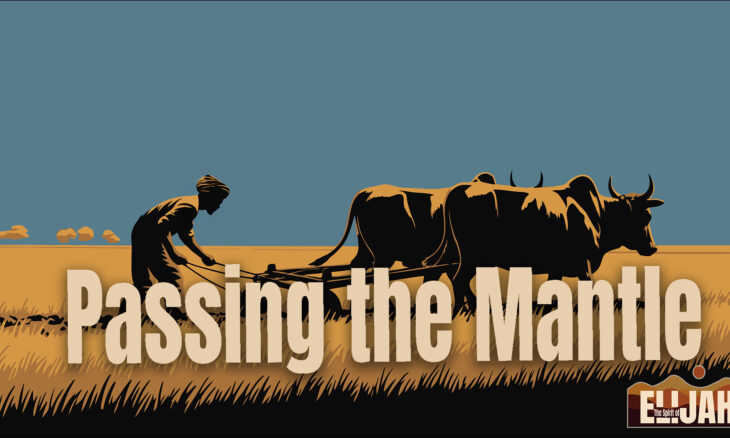
That’s exactly where we meet Elisha. When Elijah finds him in 1 Kings 19:19, there are no thunderclaps or angel choirs—just a young man behind twelve yoke of oxen, doing what he knows to do. His hands are blistered, his clothes are dusty, and his world is fairly small: field, family, work, repeat. But in that ordinary place, God is about to write an extraordinary story.
God Meets Us in the Middle of the Ordinary
We often imagine God’s call as something dramatic—a mountaintop vision, a lightning-bolt moment, a voice from heaven. But Scripture tells a different story. Moses was tending sheep when the bush began to burn (Exodus 3). David was watching his father’s flock when Samuel showed up with a horn of oil (1 Samuel 16). Peter and Andrew were mending nets when Jesus said, “Follow Me” (Matthew 4:18–20).
Elisha fits the same pattern. God doesn’t wait until his life is “sorted out” or especially spiritual. He meets him in the field he already knows, in the work he’s already doing. Ordinary faithfulness becomes holy ground.
That’s good news for us. It means your cubicle, your kitchen, your classroom, your tractor cab—these are not “waiting rooms” for God’s will. They’re the very places where He loves to whisper, “I see you. I can use you. I’m calling you.”
Paul echoes this in Colossians 3:23: “Whatever you do, work heartily, as for the Lord and not for men.” There is no such thing as “throwaway” days when you’re working unto the Lord. The small, unseen acts of faithfulness are often the soil where bigger callings quietly take root.
God’s Call Interrupts and Invites
Elijah walks past Elisha, throws his cloak over his shoulders, and keeps going. No speech. No explanation. Just a mantle landing on a young man’s back. On the surface, it looks like a strange gesture. Spiritually, it is loaded with meaning: the prophet’s cloak symbolized calling, authority, and the continuation of God’s work. This wasn’t just Elijah saying, “Come help me.” It was God saying, “You’re next.”
God’s call is often like that—personal and disruptive, but not always loud. It shows up as a deep tug in your spirit, a growing conviction you can’t ignore, a word of Scripture that won’t let you go, or a moment in a sermon that feels like it was aimed straight at you. Life looks the same on the outside, but inside, something has shifted. The plow lines in your field suddenly mark the line between the life you’ve known and the life you’re being invited into.
Elisha’s response is beautiful: he runs after Elijah. He doesn’t drag his feet, but he also doesn’t treat his past casually. He asks to kiss his parents goodbye—not as an excuse to delay, but as a way to honor what he’s leaving behind. God’s call doesn’t erase our history; it redirects it. It invites us to step forward with both urgency and honor.
Faithful Obedience Requires Letting Go
The moment that seals Elisha’s calling is dramatic in its own quiet way. He takes the yoke of oxen, slaughters them, uses the plow as firewood, and feeds the people. Then he goes after Elijah and becomes his servant (1 Kings 19:21). In modern terms, he burns his backup plan.
Elisha isn’t simply “trying out” the prophetic life while keeping the plow in the barn just in case. He declares with his actions, “I’m not going back.” The very tools that once defined him become the sacrifice that launches him into his new season.
The apostle Paul shares that same heart in Philippians 3:13–14—forgetting what is behind, pressing toward what is ahead. Following God’s call almost always involves release before reward. You let go of something secure, familiar, maybe even good, before you see what God will place in your empty hands.
For us, the “plow” might look like:
- A job that defines our identity more than Christ does.
- A habit or secret sin we’ve learned to live with.
- A comfort zone that keeps us from serving, leading, or going.
- A past success we keep polishing instead of stepping into what’s next.
You cannot fully take hold of a new calling while clutching an old one. At some point, obedience means burning the plow—turning something you once relied on into an offering that marks your surrender.
God Works Powerfully Through the Passing of Mantles
The story doesn’t end with Elisha leaving the field; it continues in the relationship between Elijah and Elisha. The cloak on his shoulders is more than a symbol; it’s a mantle to be carried and eventually passed on. Throughout Scripture, God’s kingdom moves forward as one generation hands the work of God to the next: Moses to Joshua, Elijah to Elisha, Paul to Timothy.
We often measure success by what we accomplish, but God often measures it by who we prepare. Parents carry a mantle of faith for their children (Deuteronomy 6:5–7). Mentors and disciplers carry a mantle for those they invest in (2 Timothy 2:2). Church leaders carry a mantle to serve now and to raise up those who will lead later.
Think of a relay race: the team with the best handoff—not just the fastest runner—often wins. The baton must be passed while both runners are moving. In the same way, the faith of one generation is meant to be handed off while both are running. Older believers cannot retire from spiritual influence before passing the baton, and younger believers must be ready to receive it.
You are somewhere in that exchange zone. You are either being shaped to carry a mantle, or you are being called to pass one to someone else.
Saying Yes in Your Field
When Elijah’s cloak fell across Elisha’s shoulders, a story that began in a plowed field began to ripple across generations. God still works that way today.
Maybe you sense God nudging you in the middle of your own “ordinary” field—your job, your home, your ministry, your neighborhood. Maybe He’s whispering, “It’s time to move forward,” or, “It’s time to let go,” or, “It’s time to invest in someone else.”
Faith doesn’t wait for perfect conditions. It just says yes.
So wherever you are today—hands on the plow, heart full of questions—know this: God sees you. He meets you in the ordinary. He interrupts to invite. He calls you to let go so He can lead you forward. And as you say yes, He not only writes a new chapter in your story—He uses your life to hand a mantle of faith to those who come after you.